
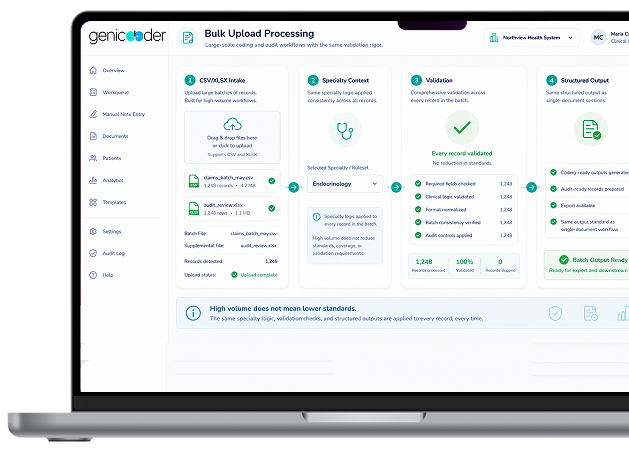

Bulk Code Generation

Code Audit Workflow

Enterprise
Organizations

Coding and RCM
Teams
How GeniCoder Reviews Existing Codes
GeniCoder reviews existing coding against the clinical documentation it came from, surfaces discrepancies as structured review items, and supports high-volume coding review without record-by-record comparison.
What medical coding audit software does
Medical coding audit software checks codes that have already been assigned. Instead of starting from a blank record, it takes the existing codes and the clinical documentation they were based on, compares the two, and points reviewers to the places where they do not line up.
GeniCoder provides this medical coding auditing software through its Bulk Coding & Code Audit module. The same module can also generate codes for a batch of records, so teams use whichever workflow fits the work in front of them.
Audit existing codes against clinical documentation
Upload existing codes alongside the clinical notes they were generated from. GeniCoder checks each code against its source note, using the clinical specialty selected for the submission, and returns the results as structured review items.
As a medical coding audit tool, it shows reviewers which codes need attention without comparing every record to every code by hand.
What types of coding discrepancies can be identified
The audit workflow flags three kinds of discrepancy between a code and its documentation:
- Inconsistencies — a code that does not match what the clinical note documents.
- Missing specificity — a code that is less specific than the documentation supports.
- Logic gaps — places where the link between the documentation and the assigned code does not hold up.
Each flag is raised as a structured review item, so the reviewer knows exactly which code to look at.
Bulk coding and high-volume review
Records are uploaded in batches through CSV or XLSX. The clinical specialty is selected once for the full batch, validation runs on every record before coding, and every submission produces a structured output.
Bulk code generation and bulk audit use the same specialty-based coding logic as single-record sessions, so output quality does not change with volume. Enterprise coding teams and revenue cycle teams can review hundreds of records without adding a manual step for each one.
Coding audit vs coding validation
The two terms are often used interchangeably, but in GeniCoder they happen at different points:
- Validation happens before coding. It confirms the submitted records are consistent — for example, that multiple documents belong to the same patient and share one specialty context.
- Coding audit happens after codes exist. It reviews the assigned codes against the documentation and flags discrepancies.
To see the reasoning and references behind an individual coding decision, use explainable AI medical coding in the Code References & Transparency module.
How auditing supports coding QA and compliance workflows
Coding quality assurance depends on consistency across volume, not just on the handful of records a senior reviewer can check. Auditing every record in a batch gives QA teams a structured list of items to review instead of a random sample.
For compliance teams, the audit output becomes part of their internal review process: each flagged item stays tied to the code and the documentation it relates to. GeniCoder supports that workflow as coding compliance software for review, while decisions about compliance stay with your team.
Review workflow and human oversight
GeniCoder does not replace the coder or auditor. The audit produces review items; people decide what to change.
- Select the clinical specialty for the batch.
- Upload existing codes with their clinical notes (CSV or XLSX).
- GeniCoder checks each code against its source note.
- Discrepancies are returned as structured review items.
- Your coders and auditors review each item and make the final call.
New records that still need coding can start from AI medical coding from clinical notes and then move into the same review process.
Frequently Asked Questions
What does medical coding audit software check?
It checks codes that have already been assigned against the clinical documentation they came from. In GeniCoder, each existing code is compared with its source note, and any inconsistency, missing specificity or logic gap is flagged for review.
Can audit software compare existing codes with clinical documentation?
Yes. In the GeniCoder audit workflow you upload existing codes alongside the clinical notes they were generated from, and the platform checks each code against its note.
What is the difference between coding validation and coding audit?
Validation happens before coding and confirms that the submitted records are consistent, such as belonging to the same patient and specialty. A coding audit happens after codes exist and reviews them against the documentation to flag discrepancies.
How do bulk coding audits work?
Records and their existing codes are uploaded in a batch through CSV or XLSX. The specialty is selected once for the batch, every record is checked, and the results come back as structured review items, so there is no record-by-record manual comparison.
Can AI review ICD-10 and CPT coding?
Yes. GeniCoder reviews existing ICD-10 and CPT codes against the clinical notes they are based on, applying the coding logic for the selected specialty, and flags the codes that need a reviewer’s attention.
How can audit software support coding compliance?
It gives compliance and QA teams a consistent, structured list of flagged items across every record in a batch, which they can use within their own internal review process. Compliance decisions remain with your team.
What types of discrepancies can be flagged?
GeniCoder flags inconsistencies between a code and the documentation, codes that are missing specificity the documentation supports, and logic gaps between the documentation and the assigned code.
What role does human review play in an AI coding audit?
A central one. GeniCoder surfaces review items; coders and auditors review each one and decide whether a code should change. The software does not make final coding decisions.