

Patient Consistency
Same patient across all submitted records.

Specialty Alignment
One specialty context across the full submission.

Early Stop on Mismatch
Caught here. Not at billing.
Patient Consistency
Same patient across all submitted records.
Specialty Alignment
One specialty context across the full submission.
Early Stop on Mismatch
Caught here. Not at billing.
A Consistency Check Before Coding Continues
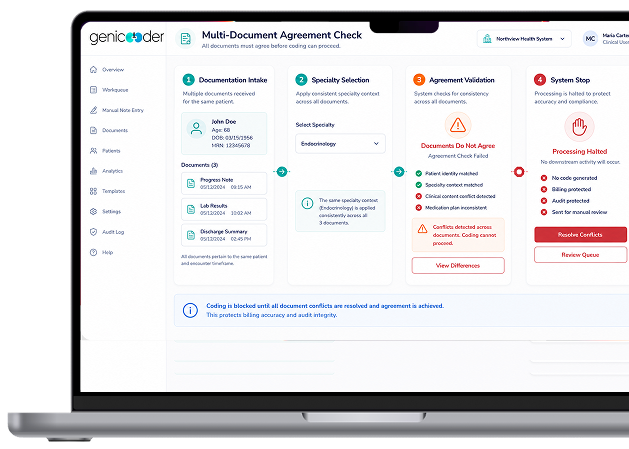
When a case includes more than one record, GeniCoder confirms the documents belong together and share the same coding context before any code is generated.
Why validate records before coding
Coding output is only as reliable as the set of records it is built from. If one document in a case belongs to a different patient, or carries a different specialty context, the codes produced for that case can be based on information that does not belong to it.
Catching that problem before coding keeps the fix simple: swap a document or recheck a patient record. Caught at billing, the same problem means rework and claim denials. Caught at audit, it means reconstructing decisions weeks after the fact. Running pre-coding record checks keeps the error at the front of the workflow, where it is cheapest to resolve, and protects the data integrity of every case.
What GeniCoder checks across multiple documents
Multi-document validation runs automatically whenever more than one record is submitted. There is no manual cross-checking and no reliance on the coder to spot a mismatch. Before processing begins, GeniCoder checks that:
- all documents in the submission belong to the same patient, and
- all documents share the same clinical specialty context.
This is healthcare document validation focused on document matching: consistency checks on the submission itself. They confirm the records can be coded together; they do not assess the clinical content of the documentation or review codes.
Patient and specialty consistency
Patient record consistency. Every document in a submission should relate to the same patient. If one does not, the submission does not move forward to coding.
Specialty alignment. GeniCoder codes in the context of a selected clinical specialty, so every record in a submission must share one specialty context. If the specialty context conflicts across documents, the system flags it and holds the submission for review.
Together these checks protect medical record consistency across the case, so the coding that follows starts from one patient and one specialty context.
What happens when records do not match
When an incompatibility is detected, processing stops before coding runs. The issue is flagged with a clear reason, so the team knows exactly what to fix — for example, removing a document that belongs to another patient or resolving a specialty conflict.
Nothing is coded from a mismatched set, which means no error from that set reaches billing or audit.
Record validation vs coding audit
Record validation and coding audit answer different questions at different points in the workflow:
- Record validation happens before coding. It asks: do these documents belong together and share the same coding context?
- Coding audit happens after codes exist. It asks: do the assigned codes match the clinical documentation?
Multi-document validation covers the first question only. For reviewing existing codes against documentation, see the coding audit tool in the Bulk Coding & Code Audit module.
Where validation fits in the coding workflow
- Records arrive through clinical document processing — PDFs, scanned documents, or bulk uploads — or are typed in directly.
- A clinical specialty is selected for the submission.
- Multi-document validation checks patient and specialty consistency across the records.
- If the records match, coding continues. If they do not, the submission stops with a clear reason.
Typed notes entered through clinical notes to codes go through the same validation checks as uploaded files.
Frequently Asked Questions
Why validate records before coding?
Because codes built from a mismatched set of records can be based on information that does not belong to the case. Validating first keeps the fix simple, such as swapping a document, instead of correcting the error later at billing or audit.
How can mismatched patient records affect coding?
If a document from another patient is included in a case, the coding for that case can draw on the wrong clinical information. GeniCoder stops the submission before coding when records do not belong to the same patient.
What should be checked across multiple documents?
GeniCoder checks that all documents in a submission belong to the same patient and share the same clinical specialty context before coding begins.
What happens when records conflict?
Processing stops before coding runs. The conflict is flagged with a clear reason, and the submission is held so the team can correct the records.
What is the difference between record validation and code auditing?
Record validation happens before coding and confirms the documents belong together and share one coding context. Code auditing happens after codes are assigned and reviews those codes against the documentation.
Can several files be validated as one case?
Yes. When more than one record is submitted together, multi-document validation runs automatically and checks the records as one submission.
Where does document validation fit before coding?
It sits between document intake and coding. Records are submitted and a specialty is selected, validation checks consistency across the records, and only a consistent submission moves on to coding.